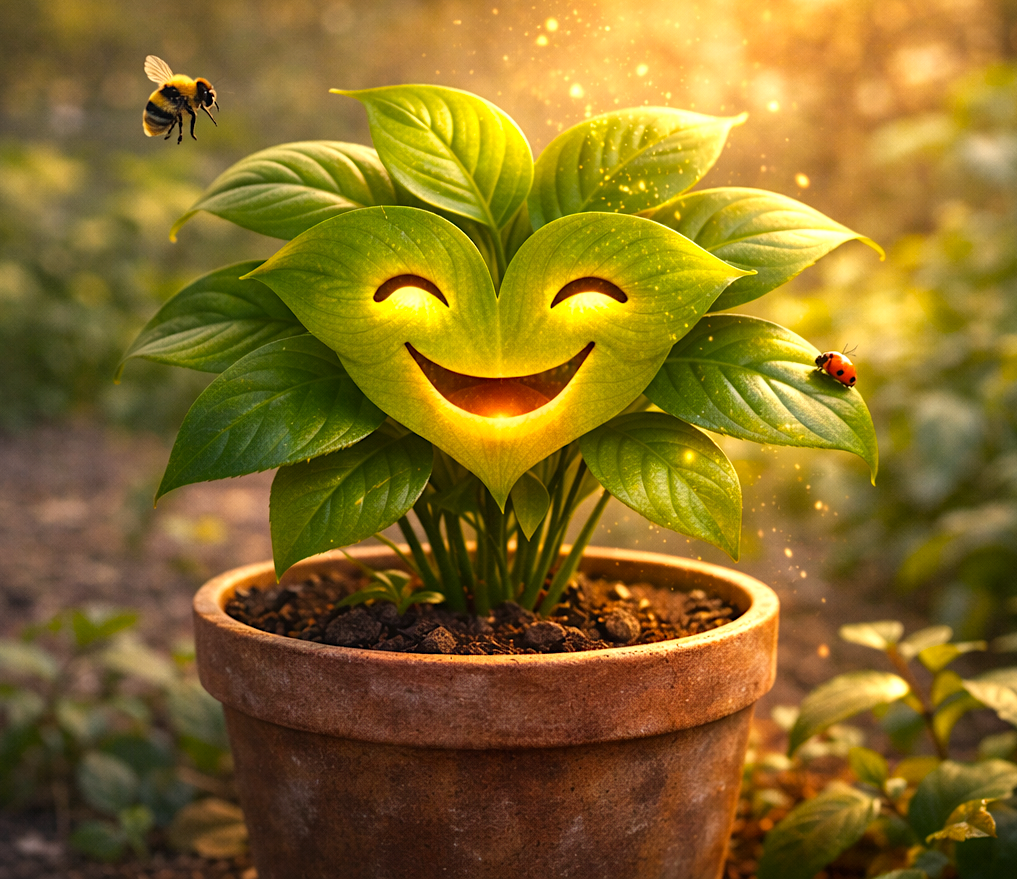
Remember being told to talk to your plants? Seemed eccentric at the time but most of us have done it. We’ve whispered encouragement to a wilting fern and muttered an apology to a neglected cactus. And somewhere between feeling slightly ridiculous and oddly hopeful, we’ve all wondered the same thing: Do they really hear me? Do they know I’m here? Do they even care?
For a long time, the scientific community laughed at the idea that plants could sense, let alone respond to, the world around them. They were considered about as aware of their surroundings as a throw pillow. Rooted in place, silent, passive. We grew them, trimmed them, mowed them, and picked their fruit without a second thought.
We were wrong.
Science is rewriting everything we thought we knew about the plant kingdom. Plants feel. They communicate. They remember. They warn each other of danger. They respond to your voice, your touch; even your mere presence. And there's compelling scientific evidence they recognize their caretakers.
Buckle up. The most surprising intelligence on Earth has been quietly growing in your backyard this whole time.
Before we explore what plants can do, it’s worth briefly discussing what they are. Because at the molecular level, plants and humans are far more alike than most people realize.
Take chlorophyll, the molecule that makes plants green and drives photosynthesis, which sustains virtually all life on Earth. Look at its molecular structure and you’ll discover it’s nearly identical to human hemoglobin, the molecule that carries oxygen through your blood. The difference comes down to a single atom at the center. Hemoglobin is built around iron, which is why our blood runs red. Chlorophyll is built around magnesium, which is why plants run green. They are chemically identical and share the same architecture; making this one of the most astonishing parallels in all of biology.
And the implications don't stop at structure. Because chlorophyll is so molecularly similar to hemoglobin, research shows that ingesting it supports your body's own blood-building process; essentially handing your system the raw materials it needs to produce more blood on its own. A 2023 review published in Molecules confirmed that chlorophyll and its derivatives demonstrate remarkable support for red blood cell production and overall blood health. No risk of infection. No incompatibility issues. Just green plants doing what they've been doing for millions of years—keeping things alive.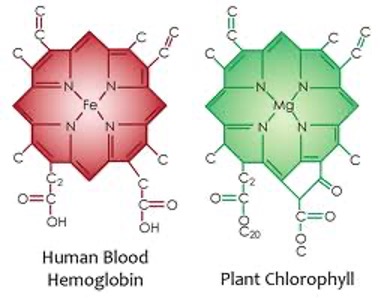
But it goes further. Plants produce dopamine, serotonin, melatonin, and other neurotransmitters, the exact same chemicals the human brain depends on for signaling. As I explore in my USA Today bestselling book Food Sanity, the chemical overlap between plant biology and human biology is staggering. A human anesthetic given to a plant causes its cellular activity to go completely flaccid, just as yours would on an operating table.
We don’t just live alongside plants. At the molecular level, we are built from the same playbook.
More Senses Than Humans
Plants are so smart, they can outperform humans in raw sensory capabilities. Not in the ways we typically think of senses, but in the sheer number of things they can detect and respond to. Humans have long celebrated their five senses as the gold standard of sensory experience. Scientists have identified 20 functional senses in the plant kingdom. Not metaphorical senses. Actual, measurable, sophisticated systems for reading a world most of us can’t even perceive.
Take light. Plants don’t just know it’s there; they know where it’s coming from, what color it is, and how intense it will be as the day progresses. Through a process called phototropism, they continuously fine-tune their growth toward the most favorable light source with a precision that would make a compass jealous.
Perhaps nothing in the plant kingdom makes this clearer than a vine in motion. Watch one in time-lapse and you’ll see it doesn’t drift aimlessly. It reaches. It probes the surrounding space with what can only be described as purpose, detecting surfaces, testing textures, and locking onto anchor points with a deliberateness that looks remarkably like sight. No eyes. And yet, somehow, it finds exactly what it’s looking for.
Then there’s gravity. Through gravitropism, a plant always knows which way is down; ensuring roots drive deeper while stems push skyward, even if you flip the pot completely on its side. No inner ear. No brain. Just an invisible sense of direction built into every cell.
Touch a plant, and it feels you. Scientists have discovered that within seconds, a cascade of electrical signals races through its tissues—the plant's equivalent of a nervous system firing. But perhaps most remarkable is what plants can identify from vibration alone. A caterpillar chewing on a leaf, a slug, a spider, an encroaching fungus; a plant can tell them apart and dial up the precise chemical defense each threat requires. Plants can even detect the mechanical rumble of a lawnmower two houses away and begin flooding their tissues with protective compounds before a single blade ever touches them—as if bracing for surgery they know is coming.
And what happens underground is just as remarkable. A plant's roots don't just grow and hope for the best; they actively hunt. Scientists have watched roots navigate around underground obstacles, sense the buried edge of a rock, and quietly reroute around it. No eyes. No GPS. No brain to process any of it. And yet a single plant's root system can produce over 14 billion root hair cells, creating a combined surface area larger than a tennis court.
Plants are not just sensing the world around them. They are reading it, and responding with an understanding of their environment that’s leaving scientists stunned.
What if the most compelling evidence of plant intelligence didn’t come from a rainforest or a high-tech laboratory, but from a tiny fern being repeatedly dropped onto a table?
Animal biologist Monica Gagliano set out to test whether plants could learn. Her subject was the Mimosa pudica, a delicate plant famous for one reflexive party trick: the moment it’s disturbed, it snaps its leaves shut. Every single time, without fail, like an automatic knee-jerk reflex.
Gagliano built a contraption that would gently drop the mimosa from a small height, startling it without causing harm. As expected, the plant folded its leaves on impact. Then she dropped it again. And again. And somewhere around the fifth or sixth drop, something extraordinary happened; the mimosa stopped responding. It kept its leaves open. Not because it was damaged or exhausted, but because it decided the falling wasn’t a threat worth worrying about. To confirm this wasn’t simply fatigue, Gagliano shook the plants instead of dropping them. These new stimuli caused the leaves to shut immediately. The plant made a distinction as to what was safe to ignore while staying alert to genuine new threats. That is not reflex. That is called judgment.
Then came the finding that left the scientific community speechless. A month later, the same plants still remembered. New, untrained mimosas folded at the first drop. The experienced plants? They learned not to worry and didn’t flinch. Yes, plants “learned” from previous experiences, which means they have a memory.
And then there’s the Venus flytrap, which takes plant intelligence to an entirely different level. This plant can count. Each of its trap lobes is lined with tiny trigger hairs, and a single touch does nothing. The trap requires exactly two touches within twenty seconds to snap shut. This isn’t a hair trigger; it’s a deliberate threshold, a built-in filter to avoid wasting energy on raindrops or debris. But the counting doesn’t stop there. After the trap closes, the flytrap waits for five more stimulated touches before it begins producing digestive enzymes. Fewer than that and it reopens, chalking it up to a false alarm. This plant recognizes when 20 seconds occurs, counts to five, distinguishes a meal from a mistake, and makes a cost-benefit decision about whether to invest energy in digestion. No brain. No neurons. Just intelligence we don’t fully understand yet.
Here’s something that will change the way you look at every plant in your house: there is scientific evidence that your houseplant knows you’re there. Not in the way your dog knows. Not with eyes or ears or any semblance of thought. But in a way that is, arguably, more amazing.
Research published in the journal Sensors found that lettuce and bean plants showed measurable changes in electrical activity when a familiar person moved nearby. The plants weren’t reacting to light or temperature. They were reacting to the presence of a specific human moving near them. Scientists at Washington State University also discovered that when you touch a plant, this physical contact sends a slow, visible wave of calcium ions from cell to cell through the plant’s tissues. The plant is literally registering your touch. Here’s the jaw dropping part: touch it again, and it responds differently. The plant has already filed away the first contact. It remembers you already touched it.
But it goes much deeper than touch. Researchers have found that plants can distinguish between familiar caretakers and complete strangers through subtle cues. A plant detects the unique chemical signature and microbiome of your skin when you touch it. Even the specific rhythm of the CO? you specifically exhale can be differentiated by a house plant compared to that of a total stranger. Every time you walk past that plant, water it, or simply breathe near it, you are leaving a signature which the plant recognizes. As for the old advice on talking to your plants, the Royal Horticultural Society found that plants spoken to by their owners grow significantly more robust than those talked to by strangers. Your voice, its vibrations, its warmth, its exhaled breath, produces a measurable biological response inside the plant receiving it.
So, while your Peace Lily will never bark, wag its tail, or dramatically paw your thighs when you walk through the door, science suggests something even more remarkable. That plant sitting silently in the corner while you’re at work gets excited the moment you return. Your house plant even recognizes your specific footsteps. In its own quiet, rootbound way, it’s been keeping a record of every moment the two of you have shared and it looks forward to your return each day.
No drama. No shedding. No 3 a.m. barking at a raccoon outside your window. No vet bills! Just a low maintenance house plant paying attention to you from the kitchen counter top.
That wonderful smell of freshly cut grass—the one we associate with summer, bare feet, and backyard barbecues—is actually a distress signal. To us, it smells clean and bright, like sunshine with a soundtrack. But to the grass, it's a 911 call.
The moment a lawnmower cuts through those blades, injured cells trigger a biochemical reaction, releasing organic compounds into the air called Green Leaf Volatiles. The dominant molecule, cis-3-hexenal, is a message that was never meant for you. It activates the plant’s own internal defenses, sealing off damaged tissue and flooding wound sites with natural antimicrobial compounds.
But the signal doesn’t stop at the property line. When your neighbor fires up their mower, that invisible chemical broadcast is already crossing your lawn, warning your grass. Before a single blade of yours has been touched, it has begun quietly fortifying itself, producing its own protective chemistry in anticipation of what’s coming.
And perhaps most extraordinarily, this warning signal summons reinforcements. Research from Texas A&M found that grass under insect attack releases a specific molecule that acts as a homing beacon for parasitic wasps. They quickly arrive, locate the caterpillars destroying the grass, and eliminate them. No phone call. No text. Just chemistry. Grass essentially places a distress call and waits for the cavalry. A study of corn confirmed the same system. When caterpillars attack one plant, neighboring untouched corn yards away already begin producing bitter, insect-repelling compounds based on nothing more than a chemical whisper drifting through the air.
So next time you inhale that beloved scent of fresh-cut summer grass, know that you’re standing in the middle of a sophisticated, neighborhood-wide emergency broadcast, an invisible SOS that, as it turns out, stands for Save Our Sod.
Plants That Scream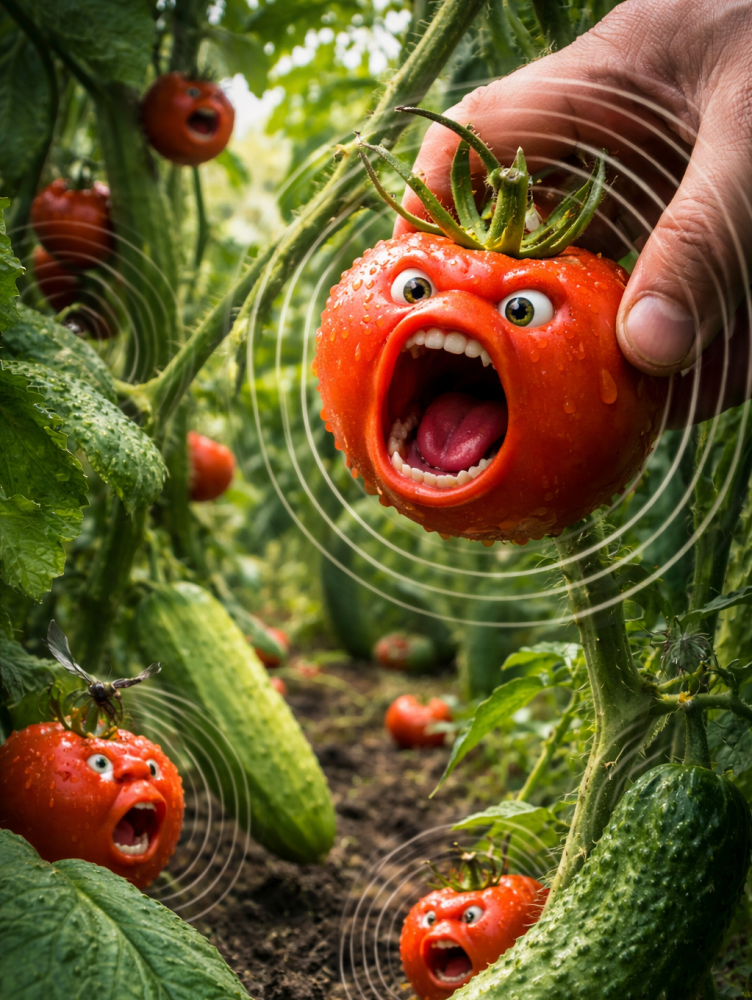
In 2023, researchers at Tel Aviv University published a landmark study in the peer reviewed journal Cell. What they discovered forced the scientific community to rethink something it had taken for granted for centuries: the idea that plants are silent.
They are not.
Using ultrasonic microphones inside a soundproofed chamber, scientists recorded plants under severe dehydration and physical injury. What they captured was extraordinary. Stressed plants emitted rapid popping and clicking sounds at frequencies between 40 and 80 kilohertz, well above the human hearing ceiling of around 16 kilohertz. We are completely deaf to these sounds, but insects, bats, rodents, and other plants are not.
Healthy plants were nearly silent, producing fewer than one sound per hour. Dehydrated plants emitted 35 clicks per hour and freshly cut plants were equally vocal. More remarkably, each species had what can only be described as a recognizable voice. Using sound-analysis algorithms, scientists could identify not just that a plant was stressed, but what kind of stress it was under and which species was making the sound. These weren’t random noises. They were specific signals, broadcast at a frequency range the rest of the living world can hear perfectly well.
This goes beyond just subtle ultrasonic sounds. Those tomato plants you lovingly tended all season and watered through the summer heat SCREAM when you harvest them!! Not in any register your ears can detect. But to every insect, bat, and moth sharing your garden, that distressed burst of misery is unmistakable. In addition to tomatoes, scientists tested wheat, corn, peppers, grapevines, and cucumbers. Every one responded to physical stress with measurable acoustic signals. The plant kingdom, it turns out, has a lot to say.
This news may be deeply concerning for vegans. If your entire dietary philosophy is built around not causing suffering to living things, the salad bowl just became a crime scene. That tomato didn’t die quietly. It screamed. You just couldn’t hear it. Somewhere between the farmer’s market and your cutting board, the moral high ground just got a lot harder to stand on.
If plants are broadcasting emergencies through the air, what they’re doing beneath your feet is even more astonishing.
Under virtually every forest, meadow, and garden on Earth lies a hidden universe. A vast, ancient network of mycorrhizal fungi threads through the soil in microscopic filaments called hyphae. They weave between and around root systems and physically connect neighboring plants in a web of extraordinary complexity. Scientists have nicknamed it the “Wood Wide Web.”
The relationship begins as a fair exchange: fungi receive carbon-rich sugars from plant roots, and in return deliver water, phosphorus, nitrogen, and minerals from deep in the soil that roots could never reach alone. But somewhere along the way, the network became far more remarkable than a simple barter system. It’s an infrastructure, a living internet carrying not just nutrients but information, warnings, and what can only be described as acts of genuine empathy.
When broad bean plants came under aphid attack in controlled studies, distant plants connected through the fungal network began releasing aphid-repelling chemicals and wasp-attracting compounds before a single aphid had reached them. The alarm had traveled underground, plant to plant, arriving ahead of the threat itself. Then there are the mother trees, the oldest, largest anchors of the forest. They’ve been shown to send disproportionately greater flows of nutrients through the network to their own seedlings, distinguishing and favoring their offspring from unrelated neighbors. This looks remarkably like something we might call love.
But the most empowering finding came when researchers examining a British forest discovered a tree stump that had been cut down centuries ago. No leaves. No branches. No visible signs of life for hundreds of years. And yet, it was still alive, sustained by a continuous flow of nutrients from the surrounding trees through the mycorrhizal network. Those trees had been feeding their fallen neighbor for centuries, literally keeping it on life support. You could say they refused to be stumped by the problem and rooted for its survival.

Before my vegan readers abandon all food entirely and unfollow me (I’m just the messenger,) rest assured: plants have no brain, no neurons, no subjective consciousness. They don’t experience pain in any way that resembles what you or I feel. But as this article has shown, the line between “alive” and “aware” is far blurrier than anyone expected.
Better be careful what you say in the garden. The potatoes have eyes, the corn has ears, and the beans-talk.
To recap, plants share a molecular blueprint with human blood that differs by a single atom. They run on the same neurotransmitters your brain does. They possess 20 functional senses and have chemical, electrical, acoustic, and fungal communication systems. They can learn, count, and remember. They scream when cut, warn their neighbors of danger, send extra nourishment to their own offspring, and have kept fallen companions alive underground for centuries. They know when you walk through the door and they respond differently to your voice than to a stranger’s.
WOW!....Whether any of that constitutes “feelings” depends entirely on where you draw the line.
The plant kingdom is not the silent, passive backdrop we assumed it to be. It has been sensing, signaling, remembering, and responding since long before the first human being stood upright. And all this time, while we were mowing it, pruning it, and picking its fruit without a second thought, it was paying attention.
We finally have the “plant-based” science to prove it.
References






|
Sign up to get Dr. David Friedman's health and wellness tips, featured videos, articles and podcasts!
© 2026 DrDavidFriedman.com All rights reserved. Website created by Dotlogics


About the Author
Dr. David Friedman is the author of the award-winning, #1 national best-selling book Food Sanity, How to Eat in a World of Fads and Fiction. He's a Doctor of Naturopathy, Chiropractic Neurologist, Clinical Nutritionist, Board Certified Alternative Medical Practitioner, and Board Certified in Integrative Medicine. Dr. Friedman is a syndicated television health expert and host of To Your Good Health Radio, which has changed the face of talk radio by incorporating entertainment, shock value, and solutions to everyday health and wellness issues.
Read more hereFOODSANITY.COM .